Sunday, November 26, 2006

Perverted Rebellions TK

If, like I once did, you thought the aging hip had limits on how insufferable they would allow themselves to become, look no further than this article in the Times to join me on the next plateau of comprehension.

The story's got a great lead:
Casey Bonham Leto, age 5 months, wasn’t to blame. Neither were his parents. Right down to his rock ’n’ roll middle name -- a tribute to Led Zeppelin’s drummer, John Bonham -- everything had been done to bestow him with rock-kid credibility at the earliest possible age: On the floor of the puff-cheeked baby’s living room in Jersey City were toy guitars and a set of Metallica nesting dolls. On his powder-blue onesie pajamas, in gothic script, were the words "My crib rocks."
Let us take the opportunity, before we lose it, to simply pause for a silent moment and acknowledge the phrase "Metallica nesting dolls."

(Silent moment.)

OK.

Well, Casey's crib might rock, but his parents most evidently do not.

Don't get me wrong. I'm not above a little onesie signage. I even bought my nephew a onesie that says "I Might Barf."

(Yes, I'm done writing "onesie" now. I know it demeans all of us.)

But while I'm happy to poke fun at my nephew's gastrointestinal amateurism, I'm equally happy to concede that by the time he's listening to music with anything resembling individual taste, I will be an irrelevant dinosaur to him. I hope some of what I like will have stood the test of time, and that he'll enjoy it, but come on. Have these clueless yuppie parents learned nothing from their own experience? They were probably against authority as teens. Would they have looked kindly upon being culturally imprinted before they could control their own bowels?

Let kids have kid stuff. How hard is that? Metallica is not for kids, whether in nesting-doll form or otherwise. Kids like anything with a beat, not the Japanese noise rock you might listen to because it was the last outpost of cool that you hadn't colonized yet. Kids like characters made of felt who express some joy, not whatever impossibly dysfunctional troupe is traipsing its way through the Todd Solondz movie you just Netflixed. Hell, sometimes they just like styrofoam boxes.

In short, kids who haven't figured out how to walk aren't painfully self-conscious about defining themselves, unlike many parents of my generation, who remain this way alarmingly late in life. Toddlers aren't fashionably dejected and resigned to it. (There will be time for that.) They're not a cool site for you to bookmark, or a new band that no one else has heard. Pitchfork's not going to give your kid a 9.4.

My parents' record collection included Anne Murray and Johnny Mathis and Broadway show tunes. They got to the bus station too late for the rock revolution. No, strike that. I'm not convinced that's true. I think they may have chosen to stand on the curb shaking their fists in the air while the rock revolution drove by and spattered them head to toe in mud. They think even the most melodic rock band is "noise," and I'm pretty sure my father still thinks the Rolling Stones (who are damn near his age) are considered cutting-edge. And on some level, I can understand my parents' musical development. When they were young, rock was tied up in notions of radical social change, which I find ridiculous, being cranky and anti-utopian way before my time.

I was lucky to fall in love with popular music at a time when it could be fashionable in a different way -- a nerdy, asocial (not antisocial) way. I wanted my relationship to music to resemble my relationship to books, and I consider myself lucky that my teen years were spent trying to figure out what Michael Stipe was saying, not taking the brown acid and thinking it would somehow correct the world's course. It allows me to feel less shame. Not much less, but less.

Now, though, even that (quieter) entry point to rock's charms has been around for some time, and kids will find a way to rebel against it, especially if their parents are crowing about it being part of the curriculum. Kids are smart that way. I console myself with the fact that children raised by parents who want them to be cool will almost undoubtedly pay the effort back double with perverted, unimagined rebellions:
"We’re undergoing a change in what it means to be a traditional parent," said Mr. Salem. "But I read somewhere that the fastest way to turn your kid into a Republican is to dress him up in a Sex Pistols T-shirt. That’s probably true."

Labels: ,

Thursday, November 16, 2006

Traffic Cop

I finally caved into the part of my ego that likes to be beaten to a pulp and posted a traffic meter on the blog. I was curious. And yep: it's just me.

Hi, me.

No, there seem to be a few of you out there, though possibly the same dozen people hitting refresh several times a day (I'm not really sure how the technology works).

So I suppose now it's time to focus on "building traffic." Ah, here are some friendly tips. Let's take a look at a few of them:

1. Use lists.

1. Done and
2. Done.

8. Announce news.

OK. The Dow finished up more than 54 points today. Milton Friedman died. The Pentagon has changed its classification of homosexuality from something like mental retardation to something like bed-wetting. (I guess they're saying that's better.)

You guys can't get that stuff anywhere else, right?

9. Write short, pithy posts.

"If all the girls who attended the Yale prom were laid end to end, I wouldn't be a bit surprised." --Dorothy Parker

11. Don't write about your cat, your boyfriend or your kids.

Man, traffic-building is easy. I hate cats, I'm straight, and I can barely support myself, much less children.

13. Write about your kids.

I left out his Rule 12: Place contradictory pieces of advice within an eighth of an inch of each other.

15. Be sycophantic. Share linklove and expect some back.

OK, time to step up to the plate ESPN, Time, and YouTube. Love's a two-way street.

18. Coin a term or two.

Branky. Tarpulent.

21. Use photos. Salacious ones are best.

Easy enough:


22. Be anonymous.

Well, the horse has probably left the barn on this one.

27. Include comments so your blog becomes a virtual water cooler that feeds itself.

I still get a few comments, but I'm not sure the volume's large enough to count as one of those big water coolers. I like to think of them more as a can of Sprite that all of us have to share.

30. Point to useful but little-known resources.

Here you go.

35. Dress your blog (fonts and design) as well as you would dress yourself for a meeting with a stranger.

This one's just kind of creepy.

44. Don't interrupt your writing with a lot of links.

Once I figured out the link technology, I found this increasingly hard to do, but I'll give it another shot if he really thinks it will help.

46. Edit yourself. Ruthlessly.

This post got through the self-censor somehow, but otherwise I think I'm decent at this.

48. Be patient.

(tapping fingers)

(checking watch)

(pacing)

Labels:

Monday, November 13, 2006

Humanoid Underground Dweller

I think I may have inadvertently created the perfect discordant experience earlier tonight. I was coming home from work, listening to the Allman Brothers. This alone is rare. The Allman Brothers recorded many, many songs, of which I have exactly two on my iPod (of the 5,814 songs I currently have on there; and no, that number isn’t my usual exaggeration for comical non-effect, it’s just the real number). The songs are “Melissa” and “Jessica,” and I only ever really listen to the former.

But this time, I was listening to “Jessica,” mostly because after staying at work until 8:00, wrestling with demonic Xerox machines when everyone else had been sensible enough to leave for home or perhaps to have minor surgery performed, I was too tired to pull the listening device out of my coat pocket and switch to a song that better suited my mood. If you’re not familiar with “Jessica,” it’s a long(ish), noodling, airy instrumental, with a main guitar figure that is arguably the perfect soundtrack for carefree motion. It could easily and appropriately accompany any of the following activities: driving on an open highway during a bright spring day; running after a frisbee between courses of a picnic in a park; running full stride among a pack of large, happy dogs.

What it does not appropriately accompany, and what made its presence so perversely enjoyable tonight, is sitting on the E train, with its doors open at the Penn Station stop, surrounded by glum, fallen faces like so many broken lamps.

In my search to locate the nexus of my recent (OK, yearlong) ennui, I’ve alighted on the subway. In its way, of course, it’s a marvel. It keeps me from making any kind of car payment, it is (despite the maddening exceptions) fairly reliable, and it is the world’s most dependable designated driver. (You never see the D train off in the corner doing a kegstand after it promised to be your ride home.)

But the commute (about 45 minutes each way every weekday) is taking its toll. Or, as a good friend who was in the city freelancing last week put it to me over lunch, with a smile on his face, “Yeah, I think if I’d been making that commute for the last five years, I would have killed myself by now.” Thanks, JF.

It’s been almost six years, actually.

For some reason, the approaching winter always makes the train population seem that much more...gross. People are splayed all over each other, children piled on top of children, the bass of neighboring headphones seems louder, the ching-ching of cell-phone video games replicates the noise of a Vegas casino floor, even the rats on the tracks seem more put out.

Tonight, on the D, there was a guy sitting in the far corner of the car. I think it was a guy. He was wearing a too-small knit cap pulled tight over his head, his bottom lip drooping down at a remarkable angle even for the sad sacks of Gotham, and he looked legitimately lost more than sad or hungry. He was of indeterminable ethnicity, and very small. If I had to guess, and I'm not joking, I'd say he was a Sherpa who had made a wrong turn somewhere west of Nepal. He was one of these people you see sometimes in the city, and I honestly don’t mean this to be needlessly cruel -- he didn’t appear nearly as destitute as many here do -- who seemed literally out of place, like someone was taking care of him and thought, “Hell, we’ll just throw him on a subway train in New York. No one will think it’s that weird.”

Normally they'd be right. But I’m starting to think things are that weird again. Can’t tell if this is a sign to leave, or a sign that it’s too late -- that I’d look to residents of other places much like that guy looked to me.

Labels: ,

Saturday, November 11, 2006

Swords vs. Machine Guns


(above, American flags in Rockefeller Center last Tuesday night)

I'll just say, for now, that I remain a political doubter. Being an existentialist (see: somewhere not too far below), I firmly believe that the most we can do is struggle to wade through the muck of human motivation and action. I've yet to come across a better summary of my broadest opinion than this passage from The Myth of Sisyphus by Camus, which I read in college: "If I see a man armed only with a sword attack a group of machine guns, I shall consider his act to be absurd. But it is so solely by virtue of the disproportion between his intention and the reality he will encounter, of the contradiction I notice between his true strength and the aim he has in view."

It's sad but true to say that I see that disproportion in many areas of life, both in mundane activities and grand schemes. I agree with many that this administration has been shameful. My greatest initial disappointment was not with the decision to go to war -- a decision I tepidly supported, perhaps partly because of the fog September 11 left me in, but for less hazy reasons as well -- but with the lack of eloquence in talking to us about that war as it unfolded. Early on, I satisfied myself with Tony Blair’s ability to speak to what was at stake. As time wore on, though, our country’s highest leaders went from just frustratingly inarticulate to arrogantly obscurant.

If he were capable of communicating his policies on even the simplest level or expressing even a shred of humility or accountability, I could manage some empathy for President Bush. After all, even among those who debate whether he’s the worst we’ve ever had, there’s very little discussion of context. The events of 2001 certainly made this one of the toughest moments in our history to be president. Not tougher than Lincoln’s time, but in some ways tougher than Roosevelt’s, because World War II was fought between clearly defined nations in a time of far less postmodern cynicism, with no fear of escalating weapons technology falling into the hands of the equivalent of Timothy McVeigh. In short, the current problems we face (even leaving aside the very large issue of Iraq and focusing on the problems that we faced before the invasion) are not new in nature, but almost certainly new in scale.

I still give little credit to theories about us having gone to war solely on behalf of certain corporations (as my father sometimes says, my cynicism has its limits), and I still maintain that the larger failures of the venture do more damage to idealistic liberal notions than to any traditional conservative theory. (We are only at war in Iraq now to the degree that Iraqis are at war with each other, and to see so many liberals essentially doubting the inherent ability of that country to manage itself -- and it’s hard to argue -- is a startling turnaround, philosophically.)

Mostly, the recent election proved little to me other than that Americans tend to be centrist and materialist at the end of the day, and to correct any very strong swings in ideological directions. (This is something I’ve been telling friends here for years, but some of them have a hard time realizing that even the most conservative strongholds in the U.S. are not easily drawn away from the center of debates, much less states with large moderate-to-liberal populations, of which there are many. That reality doesn’t jibe with the attitude many here like to have that they’re somehow holding up the pillars of civilization against the mouth-foaming insanity of the rest of the country.)

I’m happiest that we’ll now have divided government, because I think the majority opinions of the country -- especially in the younger generations -- are not reflected by the likes of Rick Santorum and others who seem to think less that Jesus’ law should rule the land than that they bodily represent Jesus in much the way Jesus claimed to represent God.

But do I buy all of the “new dawn” talk that’s making the rounds in New York (and elsewhere, I’m sure)? Please. Have any of you heard Nancy Pelosi? This is not Voltaire, people. Some things are bound to improve, from a blue perspective, but I don’t think our knottier global problems -- many of them, gasp, not lovingly crafted by W. -- are going anywhere. It will just be harder now to blame them on straw men. And that’s an improvement, too.

Labels: ,

Monday, November 06, 2006

Haggard and the American Mind

I bet that last post had you believing that I'm fresh out of ideas for the blog. Wrong again. I just honestly thought it was worth sharing. (Which is, I admit, probably worse than being out of ideas.)

Before I head out to the night's work (which will involve leaving my apartment -- which I've already mentally vacated after just two months; don't move to New York, kids -- to do some reading, lots of editing, and some suppressing of a faint notion that I should be writing), I thought I'd share some thoughts on Ted Haggard. It's what every other blogger's been doing for the past 48 hours. I might as well catch up.

Before this week, I hadn't heard of Haggard. Or maybe I had, but the name didn't stick. Honestly, even now, I feel like all I can tell you is that he was the leader of one of those particularly scary groups of Christians (the kind I'm not defending around here when I start sounding friendly to religion), that he led this group in one of those aesthetically criminal churches that looks like a home for a semi-pro basketball team, and that he's probably nearing stage two of meth mouth. (Oh, please, don't click that last link. Really. I'm sorry I even put it up there.)

And now, he's been kicked out of his church, which has led to a message on his official site noting his dismissal and saying that the site is "in transition." (I'll say. "Come back soon, when Ted will be blogging live from the chillout tent.")

I recently told a friend that I didn't understand how one could vehemently defend President Clinton's behavior with a young intern and vehemently denounce Mark Foley's recent behavior, or vice versa. There were differences in the cases, for sure, but not so great that anything but political blindness could account for completely opposite reactions to them. (And yes, I'll italicize when I damn please.) Yet, of course, we got lots of opposite reaction from both sides of the aisle. U.S.A.!!

The case of Haggard is substantively different, of course, because he has used his pulpit to aggressively argue against the "sin" of homosexual behavior and even for legislation against it, which makes him not just self-loathing but pathologically hypocritical. Unsurprisingly, the church is already circling the wagons (sans Methy), and Haggard's secretive activities will allow his side to spin the whole episode as another sad example of how homosexuality causes dark, family- and self-destroying behavior, instead of coming to terms with the fact that no one is defending what he did, per se...just imagining what a world might be like where he didn't feel compelled to turn his self-hatred into a life that's one big lie.

It occurs to me, though, just now, that imagining a world like that assumes that social enlightenment on the issue would eradicate all cases of self-denial and shame. But there are clearly behaviors and needs that are widely embraced in the larger culture that still cause people to chastise themselves. If a hundred years from now, ninety-five percent of people view homosexuality as just an acceptable, naturally occurring percentage of sexual behavior, there will surely still be some who believe the received wisdom of certain books more than the wisdom of their own instincts. Human nature. Ain't it a bitch?

Labels: ,

Monday, May 08, 2006

Goin' to the Chapel, Kind Of

A Canadian friend of mine is marrying a German woman in June, with the ceremony held in Germany. I can’t make it for various reasons, and they were kind enough to invite me to City Hall last Friday morning for the practical American side of things, witnessed by the groom’s brother.

We joked that the experience was like getting married at the DMV, but it was one of those jokes created when straight-up truth just happens to be funny. Things got off to a solid New York start on the security line to get into the building. Right before he checked our IDs, the gruff-looking guard was approached by a woman cutting in past everyone, asking if her friend could get married that day “without an ID.” The guard gave her a look that said, “Are you insane?,” but officially hemmed and hawed until he said, “I’ll let you in, but I’m not qualified to answer your other questions.” When the woman walked away, the guard instantly turned to us and said, clearly amused, “She’s screwed.”

In the first room upstairs, a woman whose disposition was almost indistinguishable from the disgruntled soldiers at other government buildings asked for the name of the bride, groom, and witness. Once she had recorded them, she loudly stamped a sheet of paper and said, “Congratulations,” misleading the groom into thinking that the official marriage had occurred with even less pomp and circumstance than he had anticipated. I was standing on the other side of the room at the time, dismayed to learn that I might have missed the nuptials. Luckily, that wasn’t the case.

I suppose you could find something cold about the setting, but I actually found it uplifting in its way. For starters, unlike drivers standing in line for a license, most everyone is happy to be there. Then there’s the graffiti on the walls -- there’s a clearly encouraged (or at least undiscouraged) practice of couples drawing hearts on the wall and filling them with their initials. It has the effect of making the place, with its yellowish hues and sedimentary layers of scrawl, look like the most hopeful and romantic restroom on the planet.

There was one more line to stand in -- at the front of which was a generic window, identical to those covering other cashiers in the room but adorned with a sign that incongruously claimed: “Chapel.” And then it was into the room where the real magic happens. A very friendly public servant used the power vested in her, etc., etc., and the next thing you know, whammo, another marriage had entered the world. The groom and his brother were moved to tears in a very charming way, and then the four of us set out over the Brooklyn Bridge, taking photos of the happiness along the way and enjoying views of the city accompanied by some champagne (none of us had eaten anything yet, so even the small cups of bubbly created a nice 1:30 buzz).

Lunch at Grimaldi’s (a famous pizza restaurant in these parts), a quick trip home to get out of the suit, and then out to Queens where the couple hosted a dinner party, catered, as a wedding gift, by a friend who has cooked at top-notch restaurants. The food was unforgettably good, and then we retired to the roof, where we watched plane after plane get alarmingly close on their identical approaches to LaGuardia. All in all, the kind of day here -- outnumbered recently -- that strongly inspires you to stick around.

Oh, I forgot: Getting in the elevator to leave City Hall that morning, who did we run into but the same security guard who had greeted us upon entering. With a happily flushed face and a friendly laugh, he said, “So that’s it. It’s done!” “Yes, yes,” we said, matching his enthusiasm. “I was with somebody for twenty years,” he said. “Then she left me for another officer. Misery loves company.”

The guy was so good-natured that we all laughed at his attempt at germane conversation, but it led me to wonder how he’d be as a greeter at another establishment, like a restaurant: “Had the fish last week. Tasty going down, but I was sick for a week afterwards.”

Needless to say, I think my friends are in for a brighter married future than the guard enjoyed, and it was an honor to be there at its official start.

The happy couple:

Labels: ,

Thursday, April 27, 2006

A Lot About Mascots. Buckle Up.

I'm just back from a Yankees game that felt like it lasted seven hours (not that it wasn't fun; it was, other than the fact that they lost to the lowly Devil Rays). But despite my heavy, heavy eyelids, I can't let the blog go blank tonight, and luckily I have a lot of material about one of my very favorite subjects, via the great Deadspin, which pointed me to this post about mascots that "need to die."

The list is entertaining enough, but where things get really fun is in the comments below it.

Some of the highlights, for those of you less obsessive than me:

One responder posts this photo of "Dinger," a mascot for the Colorado Rockies (for some reason):


Beneath it, he writes: "I was at the game when the Rockies supposedly discovered this giant dinosaur egg under Coors Field, and then was there again when the egg 'hatched' and Dinger was born. It's ridiculous."

That's awesome enough, of course, but here's some more...

Two commenters get into a war about which mascot was born first (presumably neither hatched out of an egg), Mr. Red or Mr. Met. They do look alarmingly similar, though Mr. Red's all-black eyes make him much, much scarier:


Not to be confused with Mr. Red is Big Red, the mascot for Western Kentucky University, whose inclusion on the list leads to one of his fans losing his or her cool:
I HATE YOU SO MUCH HOW CAN YOU SAY THAT THE BEST MASCOT EVER BIG RED MUST DIE??? HE IS BETTER THAN ANY MASCOT EVER. HE EVEN EATS PEOPLES HEADS!!!!!!!! WHAT IS THERE NOT TO LIKE ABOUT BIG RED?!?!?! I love Big Red!
Then there are those who don't want to defend their school's mascot, but rather to add it to death row, like this person:
I went to Northeastern State University in Tahlequah, OK. Our name was the "Redmen", our colors were green and white, our letterhead had a chicken hawk on it, and our actual mascot was something that looked like a piss-soaked rag on a green Elmo. I can't remember its name, but it was something incredibly stupid.
This person then comes back on to the board having done some research:
As an update to my previous post, the goofy-assed Elmo guy is named ROWDY and apparently has his own website here.
Lastly(!), there is this disturbing message:
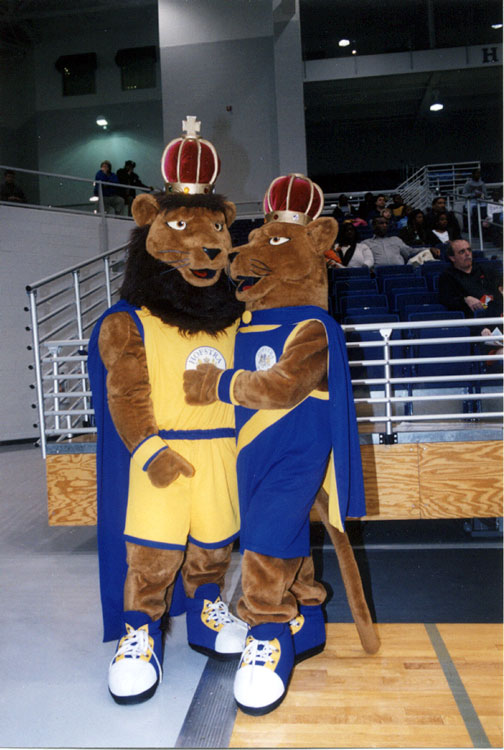
well hofstra has the hottest and best duo of mascots in sports, kate and willy, a female and male lion that ocassionaly (sic) look like they're about to have sex on the basketball court, they do crowd surfing and everything
Naturally, this led me to wonder just how "hot" a pair of mascot lions in heat could be. If you guessed, like me, "not very," congratulations:


I know it seems like I must have recapped the whole thing, but really, I didn't. Visit the page and see for yourself.

Labels: ,

Sunday, April 02, 2006

Back to Church (Literally, This Time)

My mother relocated to Long Island last fall and now lives just a few blocks from the church we attended until 1988, when Texas beckoned. (In fact, she lives much closer to the church now than we did then, but she doesn’t attend this time around, as its practices are no longer strict enough for her. Let it be said: seventeen years in Texas does things to people.)

Two weekends ago, I accompanied her to said house of worship for a memorial service for the bishop who had confirmed me when I was an impressionable lad of 12; though probably not quite as impressionable as the major players involved would have liked, as it turned out. One imagines they wanted me to be impressionable enough to remain in the church with something resembling fidelity past the age of 14. As it is, they have to console themselves with the fact that I was impressionable enough to be compulsively blogging about pseudo-religious issues 20 years later. Something tells me this is not much consolation at all. Or, rather, someone tells me: my mother. And I’m sure the bishop would, too, were he still around.

I thought he was. Under the mistaken impression that he was alive and visiting to catch up with the congregation, I got to the island with my younger sister to learn that he had passed a few months before (which I’m sure I’d been told at some point) and that the day's purpose was a belated celebration of his life. The point is, it’s a good thing I happened to be wearing a black suit.

Younger sister, whose antagonism toward all things god resembles a welder’s flame, harbored a different assumption, painfully deflated, which was that we were only going to the church’s refectory for snacks, coffee and conversation. Told there would be an actual service, she reacted in the composed, quiet, human version of how a dog reacts from the back seat when the vet’s clinic comes into view through the windshield. Not pleased.

Ironically, she should have been more worried about the eating and chatting that followed the service, as I think she’ll readily admit. First, there was the sheer nostalgic horror of the setting. It was odd enough to sit in the church where I had been a stage-frightened altar boy two decades before, but when we later descended into the Sunday school classrooms in the next building over, Leigh (calling her younger sister is getting really old, and I think all of you know her anyway) nearly shrank down to her nine-year-old size from the impact of the time travel.

Then it was up to the spread: sandwiches, cookies, coffee, wine and awkward meetings. This is not to denigrate the efforts of Mom, who in such settings is a valiant and tireless socializer the likes of which you probably haven’t seen, and who managed to steer us to a few people who were genuinely good to see after so many years. Still, like we all learned long ago, your parents’ wing span can only protect you up to a point, and eventually I found myself roaming the reception hall flanked by neither Mom nor Leigh, who had excused herself to make a phone call. That’s when I ran into two men who looked vaguely familiar (one of them had been a Sunday school teacher of mine), and had the following conversation:
Vague Man #1: So, what have you been up to? Where are you living?
Me: I’m in Brooklyn.
Vague Man #1: Huh, most people go from Brooklyn to Long Island, not the other way around. (Ed. Notes: 1. I have only a slight idea of what that means. 2. The twelve years in Texas between those two stops for me throws off whatever it does mean, I’m almost sure.)
Vague Man #2 (to Vague Man #1, as if I wasn’t there): Well, before long he’ll be looking for a house in Rockville Centre, somewhere to settle down.
Vague Man #1: That’s right.
Vague Man #2 (staring into the distance now, as if both myself and Vague Man #1 weren’t there): It’s the circle of life. (Quick, bitter laugh; still aimed into the distance.)
I’m not one to be visibly rude, even in social situations I’m not enjoying, but the shudder that passed through me at that moment possessed the force to literally turn my body from these two men. So repositioned, I quickly walked away. Having been, essentially, a creature of the suburbs until I was 26, I often defend them against the most ridiculous and paranoid portraits. Still, there was something about that 30-second exchange that chilled me to my core.

Then it was off to do a bit more wandering, and I was struck by something. I’ve realized for most of my adult life that church -- for most people, I think -- is first and foremost a place to get together. To mingle. (Granted, this is because Episcopalians are really good at that side of things. My father was raised Irish Catholic, and even though he's not particularly God-fearing himself, he would often bemoan our churchgoing experiences when I was a kid, saying things along the lines of, "I don't go to church to eat pancakes; I go to hear about how I'm going to burn in Hell if I don't shape up." Which always made me laugh, partly because it's closer to the truth to say he went to church as a down payment toward watching football later that afternoon in relative peace.) It’s not that the minglers don’t believe in God, obviously, but more that they don't seem outwardly invested in believing in God. When you go to a baseball game, you often hear fans on the concourse talking about statistics and injuries and impending match-ups. When you go to a reading, you hear people discussing the author’s work, or recommending books to each other. Even at highly rated restaurants, patrons surely talk about the food, the service, the decor. But after a church service, no one’s talking about God, or their spirit, or large questions of morality and mortality. Not in my experience, at least. And I think that’s the second reason I don’t like church. The first reason is that I don’t believe in the story its built to house, of course. But if I did, I think it might be even worse. I’d find myself shouting over the croissants and decaf: Where’s the engagement with our subject? Surely, your soul’s credit rating or God’s relationship with the universe or how to make earth a bit more heavenly is of slightly more import than whether Ken Griffey’s hamstring is going to heal before the All-Star break, so why can’t we talk about it? (Luckily, being a non-believer myself, I’m able to fervently discuss Griffey’s hamstring without such concerns. Whew.)

I also think this is why I love discussing religion with those who are no longer directly influenced by it but still wrestle with the one-time influence it had -- because unlike true believers and confident naysayers, the subject means something to them in a way that isn’t always obvious to them, and that makes for good conversation. And when talking about it, I prefer whiskey to coffee, and Radiohead to hymns.

Labels: ,

Monday, March 20, 2006

Guilt in the Mail

I had three -- count 'em, three -- bills in the mail today. Considering that I get four bills every month, that's a disproportionately rough day. But worse than any of the bills was a letter that I left unopened. When I got Internet and cable TV service through Time Warner a few months ago, I tacked the company's phone service on for convenience and ditched Verizon. I felt bad about it at the time, even though Time Warner convinced me it was a better deal. A few weeks later, I got a form letter from Verizon saying, essentially, "we're sorry that you weren't satisfied for some reason, but we'd love the opportunity to make it up to you in the future if you'll ever take us back." It was kind of emotional. Today, I got a red envelope in the mail, with the Verizon logo prominently displayed alongside this phrase: "What do they got that we haven't got?"

As self-incriminating as this is, it's not an exaggeration to say that I felt a sinking sensation upon reading this question. I felt bad for Verizon, a faceless corporation that I've probably cursed on numerous occasions in the past. Right now, to hopefully move past this once and for all, and if you'll excuse such an unorthodox move, I'd like to address Verizon directly:

There's probably a good, multipart answer to what "they" have that you haven't got, V., but that's not even the point. (And "they" have a name, and you know that, V. Their name is Time Warner.) The point is, I decided to move on. We had our run, but that's over now. Time Warner's not perfect -- look, it's digital service, so it's totally unavailable during a power outage, even emergency numbers! -- but they're my phone service provider now, and it's not fair for you to be asking me hurtful rhetorical questions first thing in the door after work. It's not cool. So can we please just get past this?

Labels:

Breaking a Promise; Talkin' Hillary

I realize now that my promise to avoid writing about the maneuverings of presidential candidates until closer to the 2008 election will be impossible to keep. In general, though, I’m an honest guy. Really. Don’t start mistrusting me left and right because of this. I’d hate for that to happen.

Two Sundays ago, The New York Times Magazine ran a piece by Matt Bai discussing the Democratic hopefuls, and whether anyone will gather the steam necessary to knock Hillary Clinton off the top of the ticket. Bai used Mark Warner, governor of Virginia, as his primary case study.

I had a few reactions to the article:

1. The New York Times not only doesn’t want Mark Warner to be the Democratic candidate in 2008, it might hate him on a personal level. It might want him deported to Gitmo. Warner may have done something inexcusable to every staffer of the Times, even every member of each staffer’s nuclear -- no, extended family. I say this because Mark Warner is, if a little goofy, an average looking person. But the portrait the paper chose for the cover of the magazine (which I can’t find online, unfortunately) makes him look not only like the love child of the most dishonest real estate agent in history and a talking donkey, but a donkey-agent about to uncork a cringe-inducing pickup line in your general direction. Looking at this picture, I don’t just want to keep him off the presidential ticket; I want to keep him at least 300 yards away from any children I might have one day. And this seems unfair, because it really appears that the Times must have digitally made him creepier (the paper has already admitted to altering the color scheme of his shirt and blazer from blue to a hideous pink and purple).

2. Democrats are idiotic. I can say this because I’m proudly listed as an independent voter.

Here’s an excerpt from the article:
The party’s insiders, expecting Clinton to be a virtually unstoppable force, seem to be falling in line behind her, which means there will be only so much additional money and organization left over for those who would challenge her. But more than anything, Democrats will tell you that they are desperate to win next time around, and a lot of pragmatic activists and voters worry that Clinton is simply too divisive a candidate to take back the White House. (In a Gallup poll in January, 51 percent of respondents said they would definitely not vote for her.)
Which leads me to wonder what part of “definitely not” Democrats don’t understand. I mean, we’re at a simple majority of 51 percent here before you even broach the subject of “maybe not” or “we’ll see how I feel after breakfast that day.”

3. (Following directly from #2.) The Democrats are going to lose the next presidential election.

That is, unless the Republicans somehow get together and decide to nominate Jacques Chirac. Here’s the article again:
Clinton encounters ambivalence online because she is a fixture of official Washington, and because she continues to emphasize her cooperation with like-minded Republicans. The party’s online activists don’t want to hear about the compromises it takes to govern; they want someone who will derail the Republican agenda, even if he (or she) has to strap himself to the tracks with two fistfuls of dynamite to do it.
So, the Democrats are split into two camps, as far as I can see: One is the party insiders, who will back Clinton just for the satisfaction of being on the winning team within the party, even if it means not winning the big prize. The other is a clear minority in this country, composed of people who want dynamite-strapped true believers to derail the Republicans, even though no one with that platform would be allowed to enter the larger D.C. area, much less the actual White House.

This is a fairly conservative country, and I don’t even mean that it’s populated mostly by foaming-at-the-mouth Bible-beaters -- I really don’t think it is. They exist, of course, the foamers, but there’s also a vast expanse of centrist people. They are damned hard to please, though, and no one proves that more than Hillary's hubby. In 1992, Bill Clinton won 43% of the popular vote. In 1996, as an incumbent in peacetime, without Monicagate on the public radar, with unprecedented wealth and happiness reigning from sea to shining sea, and running against an uninspired Bob Dole and a dangerously unmedicated Ross Perot, Clinton, a man who’s been praised as the most brilliant natural political talent we’ve ever seen, a centrist from a Southern state, won 49.2% of the vote. Not even half. Against Dole. And Perot.

Now we have Hillary, a smart, successful, hardworking candidate, who 51% of the country would never vote for. Ever. She’s a stiffer public speaker than Bill. She brings almost all of his negative baggage onto the flight with her, and less than all of his gifts.

4. Please, let’s not make this about feminism.

To the article, once more:
It is a perilous mission that Warner and other Democratic hopefuls undertake as they try to cast doubts about (Clinton’s) electability without appearing to attack one of the party’s iconic figures. And it’s risky not just because she is a Clinton, beloved by most of the party’s important interest groups, but also because she is a woman; a lot of voters may wonder if a woman can really be elected president, but they would most likely turn on any male candidate who was crass enough to imply as much.
Reducing this to the electability of a woman is nonsense. It’s like arguing (not quite, of course, but go with me) that the country isn’t ready to elect a black president because Al Sharpton isn’t in the White House yet. I suppose it’s possible that we’re not ready to elect a black president, and that would be sad, but the fact that we’re not ready to elect Al Sharpton is only a sign of collective mental health.

And finally:

5. Democrats are idiotic.

Forgive the repetition. But in the fall of 2000, I was working without pay for a literary-political magazine in New York. As the presidential election neared, a dry-erase board went up in a hallway, and all of the magazine’s staffers wrote down their choice for president. About a dozen people volunteered their preference, all of them writing “Ralph Nader.” These were very well-educated, widely read, socially concerned people, and somehow they had convinced themselves that the necessary response to Clinton’s eight years of success was not the election of his tag-team partner, but of Ralph Nader, a man whose major qualification seemed to be that he once hectored a bunch of us into wearing seat belts more often. They were, in short, insane. (Of course, I’ve come to learn in my ensuing years around these parts that they were likely just participating in a perverse level of self-definition with this vote, like youngish, smart New Yorkers do whenever they self-sabotage an election or buy one cheap beer over another or talk with incredible contempt about something they had enthusiasm for seven minutes ago.) The point is, Bush won, and being in NY and at the headquarters of said magazine, I know how deeply this pissed people off. The benefit of this, of course, was that by the time 2004 rolled around, liberals were willing to acknowledge that maybe, just maybe, there was more of a difference between Dems and Reps than ol’ Ralphy Boy had wanted us to believe. (The fact that they would have nodded along with Ralphy Boy on this point in the first place boggles the mind, and is reason #3,988 that I’ve vowed to never officially join the lefty ranks.)

Now it’s almost time for the 2008 frenzy. Bush’s second term is widely regarded as a disaster, and it’s not even close to half over. If there’s a lesson in what will be the past eight years by the time we vote for prez again, it’s twofold: The Republicans know how to win this thing, even when the chips are down; and “electable” means something different for the Democrats than it does for the Republicans. The party’s got to figure out just what that means, but I’m pretty sure it’s not Hillary Clinton.

Labels: ,

Thursday, March 16, 2006

The Unbearable Lightness of Gym Membership

I've belonged to a gym for quite a while now, and almost never go. Dumb, I know, but the way I see it, I've reached an age (never you mind) where having the membership fee show up on my credit card statement each month, despite not having lifted a leg, an arm, or even a towel at the gym during that time, serves as a useful reminder of: a) my stupidity, b) my laziness, and c) my protracted physical decay. The hope being that my cumulative shame in the face of a-through-c will eventually motivate me to walk the...oh, it's so embarrassing...three long blocks to my gym.

Well, tonight I did. I jogged/ran/spazzed a couple of miles on one of those low-impact machines ("low-impact" being perhaps my favorite hyphenated term in the English language). One of the motivating factors in making tonight my first visit in @&@!*% -- in addition to feeling edgy and run-down enough lately that I'm willing to try anything -- was the thought that I could watch an NCAA tournament game on one of the gym's TVs. (I like to replicate the experience of sitting on my couch as much as possible when I work out; this can't be good, I know.) To my astonishment, they didn't have the tournament on every monitor. So I had to turn my head a bit to watch the game, an added bit of physical activity that I resented. The set straightaway in my line of vision was on a music channel showing clips by Britney Spears, Audioslave, and the great Hall and Oates, who have to hold the record for Most Dorky Videos Set Against a Black Background.

At one point, my machine flashed a reading titled "heart rate." The reading was 155. Now, I'm no cardiologist, but I believe that a human heart beating 155 times a minute has reached, technically, "the phase of imminent explosion." I consoled myself with the fact that the machine couldn't possibly be reading my vitals accurately (or at all). But those scrolling numbers can really freak you out -- they're like a Dow Jones ticker of personal doom (heart rate: 485....good this will do if you don't stop drinking: 0....days between tonight and your next visit: 297....)

Stupid machine. Stupid heart.

Labels:

Tuesday, February 28, 2006

My Favorite Records

"Your favorite music
Well it just makes you sad
But you like it
'Cause you feel special that way."
--Clem Snide

I've been swamped, and so neglecting longer posts. Apologies. But nothing serves as filler like lists, and tonight while at a bar with two friends, the three of us promised to swap our top-20-album opinions by the end of the week. Going through my collection, I had to give myself a break, so I settled on 25. Even that was painful. I can divide those I left off into five categories:

1. Some of my favorites (and all-time greats) who have a body of work I love more than any single effort: The Beatles, Aretha Franklin, Stevie Wonder, Paul Simon, Lyle Lovett, Everything But the Girl, Low, Prince, Morrissey/The Smiths.

2. Great one-off albums by those who are otherwise uneven or forgettable, like Something to Write Home About by The Get Up Kids, 100 Broken Windows by Idlewild, Music for the Morning After by Pete Yorn, or New Miserable Experience by the Gin Blossoms.

3. Relative newcomers who I've listened to a ton over the last year or two, but who need a bit more time to be considered, like Mindy Smith, The Postal Service and Ray Lamontagne (the most likely to eventually make the list). Conversely, oldies-but-goodies from my high school and college years who have been considered for a bit too long to be judged accurately, like the self-titled debut by School of Fish, Are You Driving Me Crazy? by Seam, or Bandwagonesque by Teenage Fanclub.

4. Classics that deserve mention, like Blood on the Tracks by Dylan, OK Computer by Radiohead, or anything else by REM before 1993 (it took a lot of willpower to limit myself to four by them).

5. Then there are the records that could easily have made the list if I made it on a different day (or after one less -- or more -- drink) -- meaning, the most arbitrary of those left off, like When the Pawn by Fiona Apple, The Sunset Tree by The Mountain Goats, The Moon My Saddle by Chamberlain, Since by Richard Buckner, Redo the Stacks by Centro-matic, Rumours by Fleetwod Mac, or The Southern Harmony and Musical Companion by The Black Crowes, a great record by a band that otherwise occupies a lukewarm place in my heart (at best).

On to the list, after two more caveats: First, yes, there are only four works on display here that were released before 1991. Unlike many of my friends, who had older siblings (sometimes significantly older) who were schooling them in the classics of rock, I had (and have) a very lovely older sister whose taste ran more towards classical music from the day she was born. (In short, she's smarter than I am.) Her idea of cutting-edge modern music, even in college, was the Indigo Girls, Tracy Chapman, and Billy Joel. Listen, I still own (and unashamedly enjoy) music by all three of those named, but I think you see my point. I was deep into my junior year of high school before I started to form what would become my own distinct taste. ("Distinct" here defined as "shared by millions of other teenagers who watched 120 Minutes every Sunday night.") And while I've come to love The Beatles and the Stones, and respect a lot of other fogeys, they just didn't reach me when they needed to. Bands are like girls (or boys, if you prefer) -- the ones that get to you first change you the most. Or, to quote a great line from Life of Pi by Yann Martel, "first wonder goes deepest; wonder after that fits in the impression made by the first."

Secondly, I stress the obvious fact that subjectivity has been embraced. There was a discussion about #3 at the bar tonight, for instance, during which I admitted it's a flawed choice under a microscope. But it's also the initial domino that fell 15 years ago and led, pretty directly, to the 5,000 or so songs I'm choosing between as a soundtrack while I write this. So, as ever in these pursuits, objectivity be damned!

OK, sorry, but thirdly, a bonus (of what, I'm not sure) to whoever comes closest to accurately predicting "Dezmond's" eventual total word count in his replies to this post. My guess is 5,820.

25. It’s a Shame About Ray -- The Lemonheads
24. Fables of the Reconstruction -- REM
23. Into the Music -- Van Morrison
22. Siamese Dream -- Smashing Pumpkins
21. Original Pirate Material -- The Streets
20. Strangers Almanac -- Whiskeytown
19. Cake -- Trash Can Sinatras
18. Ben Folds Five -- Ben Folds Five
17. The Joshua Tree -- U2
16. Big Red Letter Day -- Buffalo Tom
15. Girlfriend -- Matthew Sweet
14. Where It Goes -- Lori Carson
13. Still Feel Gone -- Uncle Tupelo
12. August & Everything After -- Counting Crows
11. Murmur -- REM
10. A Century Ends -- David Gray
9. Bloomed -- Richard Buckner
8. Glow -- The Innocence Mission
7. Achtung Baby -- U2
6. Perfect From Now On -- Built to Spill
5. Our Time in Eden -- 10,000 Maniacs
4. Trace -- Son Volt
3. Out of Time -- REM
2. The Bends -- Radiohead
1. Automatic for the People -- REM

Labels: ,

Thursday, February 16, 2006

The Mountain Goats: An Appreciation

(This will be a long post, but forgive me; it’s my 200th, so I’m celebrating with a clearance sale on logorrhea.)

My friend Brad and I once considered the following barroom question: If you were a musician who had to perform for one night drawing on the songbook of only one artist, who would it be? My answer -- and if memory serves, his, as well -- was Paul Simon. I still don’t see a way around him. Between his solo material and his work with Monsieur Garfunkel (if French is the most beautiful language, is there a less French word than Garfunkel?), you’ve got a treasure trove. Consistent yet diverse both melodically and lyrically, a palette of those songs could make anyone look good.

I bring it up because, despite my unchanging answer, I’ve spent the past four or five days unable to stop listening to the Mountain Goats, a band essentially composed of one guy named John Darnielle. (I've had several albums of his for several years, but this recent addiction is a new phenomenon.) And while a more old-fashioned music listener -- either one of my parents, for instance -- could appreciate much of Simon’s work but would run screaming after a couple of songs by Darnielle, he’s probably one of two or three songwriters (with the emphasis on writer) who I would put in Simon’s class.

He can’t sing particularly well, but it’s misleading to stop there. His vocals are raw, without argument, and would be judged immediately -- on several songs in particular -- as unlistenable by anyone with a bias against adenoidal voices. I’ll come back to that, though.

Darnielle’s lyrics are front and center, in many cases barely less so than if he was working as a poet. Since most of his songs -- especially those that came before his last couple of albums, and there were literally hundreds of them -- feature a very simply strummed guitar and the previously described voice-a-mother-and-maybe-a-few-others-could-love, and even those elements are amateurishly captured with antiquated recording equipment, it’s a good thing the lyrics are mostly brilliant.

When he was interviewed by Daniel Handler (a.k.a. Lemony Snicket) in The Believer last year, Darnielle said:
I feel like there are some people who should be working more baroque forms and there are some people, like me, who are better suited to do something really simplistic. I did have classical training on the piano, and I’d like to think that if I devoted myself to it I could do what Franklin Bruno does. I guess it depends on where your heart is. For me, a three-chord song that comes in, does what it needs to do, throws in some little fill at the end and gets out of Dodge is always going to be what I love best.
Songs like “Family Happiness” -- and yes, he references Tolstoy in the first verse -- are mostly built with the ballast of several writerly styles; the occasional imagistic jab of a poem, the pleasingly detailed miniature of a good short story, and the more casual style of rock lyrics. The second verse of that one:
Long winding Canadian highways,
innumerable evergreens.
Weather forecast on the AM radio
says we'll be expecting highs in the low teens.
When I mouth my silent curses at you,
you can see my breath.
I hope the stars don't even come out tonight.
I hope we both freeze to death.
Look at the person I've turned into, tell me,
how do you like him now?
No standards of any kind, no creeds to disavow
I am right here where you want me
do what you brought me out here for.
You can arm me to the teeth.
You can't make me go to war.
OK, I should’ve mentioned this is one depressing dude. A friend was recently reading Philip Larkin and said it wasn’t helping his mood, which is understandable, and like Larkin, it's possible that Darnielle will only help your mood if: a) you’re so happy that even dour art won’t dent your armor, and might even make you feel that much better by contrast, or b) you’re so dour that dour art is the only kind that's currently consoling. (If I admit that it’s been b. for me the past couple of weeks, can we just move on? I promised myself this blog wouldn’t turn into a full-fledged diary. Thanks.)

Whereas Simon is often expansive in his sentiment, even when dealing with the thwarted hopes of specific people...
So I looked at the scenery, she read her magazine
And the moon rose over an open field.
"Kathy, I'm lost," I said, though I knew she was sleeping.
"I'm empty and aching and I don't know why."
Counting the cars on the New Jersey Turnpike:
They've all come to look for America
...Darnielle shows us human relationships that are absolutely claustrophobic:
We may throw the windows open later
But we are not as far west as you suppose we are
Hot wind coming off the water
The sky gone crazy with stars
While we stay here we imagine we're alive
Or this:
I am not going to lose you
We are going to stay married
In this house like a Louisiana graveyard
Where nothing stays buried
On Southwood Plantation Road
Where the dead will walk again
Put on their Sunday best
And go with unsuspecting Christian men
La la la la la
Or this (thanks for indulging me), more outward-looking in its initial observations but no less despairing:
Window facing an ill-kept front yard
Plums on the tree heavy with nectar
Prayers to summon the destroying angel
Moon stuttering in the sky like film stuck in a projector
And you
Those lines are the opening verse to “Tallahassee,” the title track of a concept album about a couple that moves to Florida and essentially drink themselves (or at least their union) to death.

And I suppose this is where I go back to his singing, because all of this sounds so grim, but it’s not. Or not quite. There’s something boyish about Darnielle’s tone, and like most effective singers, regardless of their natural gifts or lack thereof, he knows how to deliver his songs. And amid the long sentences and listed observations, he occasionally nails a minimal, elemental moment, as when he repeats “I’m coming home, I’m coming home” in “Elijah,” or sings “I am losing control of the language again” in “Masher.”

It should be clear at this point that anyone looking for musical tapestry is in the wrong aisle. In that same interview with Handler, Darnielle said of his younger years:
My prog friends thought Lou Reed was a joke. ... They would say “Do you like this because it’s funny that he can’t sing?” and I’d say, “No, that’s not it,” and they’d say, “Well it has to be, there’s no good guitar,” and I said, “It’s different from that.”
Darnielle is different from that, too, and different from Reed while we’re at it. Reed is all cool detachment (even if it’s ironic) in a lot of his best songs, whereas Darnielle is so invested that even his cheekiest material can be moving. That’s clearest in “The Best Ever Death Metal Band in Denton,” which has a jokey title, and even many jokey lyrics (very casually crafted on the page, but again, delivered well), but somehow you empathize with its characters when you’re done laughing (or, even more impressively, while you’re laughing). I reprint the whole thing here because I think it’s instructive, and because I like taxing your patience in order to test your loyalty:
The best ever death metal band out of Denton
were a couple of guys
who'd been friends since grade school
One was named Cyrus
the other was Jeff
and they practiced twice a week in Jeff's bedroom
The best ever death metal band out of Denton
never settled on a name
but the top three contenders
after weeks of debate
were Satan's Fingers and the Killers and the Hospital Bombers
Jeff and Cyrus believed in their hearts
they were headed for stage lights and lear jets
and fortune and fame
So in script that made prominent use of a pentagram
they stenciled their drumheads and guitars with their names
This is how Cyrus got sent to the school
where they told him he'd never be famous
And this was why Jeff
in the letters he'd write to his friend
helped develop a plan to get even
When you punish a person for dreaming his dream
don't expect him to thank or forgive you
The best ever death metal band out of Denton
will in time both outpace and outlive you
Hail satan
Tonight
Hail satan
Hail, hail
Allegedly, Darnielle actually has a thing for death metal, claiming that he can’t listen too much to people who traffic in his brand of quieter, more literary rock. From the same interview, and it’s the last time I reference it:
HANDLER: You are revered as a sort of cuddly troubadour.
DARNIELLE: I was always hoping people were afraid of me.
HANDLER: I’m not aware of anyone who’s afraid of you.
DARNIELLE: Then I’m not doing my job.
I can’t imagine people are afraid of Cyrus and Jeff either, despite their Columbine-like potential energy, because Darnielle makes them too three-dimensional for that. In The New Yorker last May, Sasha Frere-Jones wrote:
Cyrus and Jeff are familiar Mountain Goats characters, long on bad luck and short on problem-solving skills, and Darnielle, through his poetry, grants them the dignity that eludes them in their lives.
I disagree with this notion in general, and so here as well. Darnielle’s poetry doesn’t grant dignity to his characters, it simply illuminates the dignity already there. (It’s unfair to raise this distinction here, because it deserves further exploration, but I need some sleep and most of you aren’t still reading at this point, anyway.)

In the same piece, Frere-Jones calls Darnielle “America's best non-hip-hop lyricist.”

With all due respect to the great hip-hop lyricists, I really don’t think the qualifier is necessary.

Labels: ,

Thursday, January 26, 2006

Oprah and Frey: The Last Post (One Fervently Hopes)

For those who missed it, Oprah reduced James Frey to a stoic-looking-but-quivering-on-the-inside mass on her show today, even forcing him, in the waning minutes, to say things like, "After today, hopefully I'm a better person." (I'm paraphrasing; I would've written down exactly what he said, but I was too busy zipping up the body bag on Western civilization.)

I only caught the final segment. I'm told that most of the show was devoted to a panel of cultural talking heads taking Frey to task. The schoolmarms included Frank Rich (America’s schoolmarm laureate) and an anonymous geek from the Poynter Institute tying the moment to a larger social trend of dishonesty. As my friend Nick rightfully asked, “What’s new about lying?” Sadly, it seems that what’s new is lying to Oprah. No one will directly say that, of course, but this entire story arc -- from the book’s enormous commercial success to the blow-up about its fabrications to today’s circus of castigation and insincere atonement -- only exists because of O’s orchestration. I’ve always thought her self-righteousness was her least appealing trait, and I had seen signs that it was abating, despite her ever-increasing fame. But today had to be a new low, when she allowed people to say, with a straight face, that discovering the truth of this situation is partly important because of movements like Holocaust denial. Because, you see, a fame-hungry memoirist’s self-aggrandizing is the equivalent of people denying systematic genocide. (And don’t bring up slippery slopes -- to me, this correlation is as absurd as implying that gay marriage will lead to the union of man and cat.)

The more platitudinous and therapeutic the whole thing became, the more the exercise backfired on Oprah, reinforcing her role as the dupe rather than turning her into a healer (more accurately, she sought to become a double-healer today -- first helping save her audience by introducing it to Frey's tale of redemption, and then rushing, if sternly, to FREY'S aid when it turned out he, the pathological liar, was the one who needed her). But anyone who knows anyone with similar ambitions could see that Frey had been triumphant and would remain so, despite what must have been the most humiliating 60 minutes of his life. This was not a member of the parade of everyday Americans who kneel with good intentions before Oprah or Dr. Phil hoping to magically learn how to shed pounds, or save more money, or get along better with their spouse. Frey's a calculating, ego-driven writer who’s been milking his lies in the media since the day the book was published, and his goal was to write something that got him national attention, truckloads of money, and another bestselling book or two. He didn't get much of any of those at first, since the consensus seemed to be that the book, entirely true or not, wasn't particularly good. But thanks to Oprah, he got all of it, and no matter how many times she puts him on the couch, she can’t reverse that. Both of them can only look worse and worse from here on out, and they seem devoted to doing just that.


***

Meanwhile, Nick and I trawled through some past Oprah transcripts and found that falling prey to famous works of literature is nothing new for her. With the help of our pal PF, we exhumed a few other examples of original titles that somehow became inflated in the editing and publishing process. I think you’ll be shocked:

Forty-five Minutes of Solitude

The Pretty Good Gatsby

Love in the Time of Post-Nasal Drip

The Second Cousins Karamazov

The Middle-Aged Man and the Pond

Duluth According to Garp

Indigestion of a Salesman

To Catch and Release a Mockingbird

Breakfast at Macy’s

Squabble on the Bounty

Gulliver's Armchair

As I Lay Napping

Bright Lights, Philadelphia

Zhivago the Med Student

Labels: ,

Wednesday, January 25, 2006

Chuck Norris Threatened to Roundhouse Kick Me if I Didn't Post About Him One More Time

The Chuck Norris posting seemed to be popular with the kids, so like a craven Hollywood executive, I had to figure out a way to extend the franchise. I tried to get Burger King to design a series of souvenir cups, but I don't know anyone at Burger King. So instead, for the second (and final, I'm sure) Norris post, I asked my very funny friends to come up with their own entries. Despite having jobs, wives, children, and nasty, nasty opium habits, they complied. Being an editor, I've taken the liberty of selecting my favorites. Thanks to Brad, Matt, Jason, Nick and Jon (and myself) for these:
Chuck Norris invented fire by staring into a forest until the trees huddled together, shivering from terror. On a related note, Chuck Norris himself is not flammable.

Chuck Norris once won the Tour de France on a Big Wheel. He completed the entire event in 45 minutes.

Einstein theorized that nothing can go faster than the speed of light, which is constant. However, scientists have recently learned that light can travel even faster ... when it's running from Chuck Norris.

Chuck Norris' favorite food is HoHos. .. Wait, not "HoHos." I meant "hobos."

Jesus Christ died for everyone’s sins except Chuck Norris. God granted Chuck clemency out of fear.

Chuck Norris never learned to read. He didn't have to; letters rearrange themselves to be understood by him.

You never see the dark side of the moon because it's too frightened of Chuck Norris to show its face.

Two roads diverged in a wood, and Chuck Norris--
Chuck Norris split himself in two
and took both.
And that has made all the difference.

The original opening line of "Anna Karenina": "All happy families are alike, in having never had occasion to meet Chuck Norris. Each unhappy family met Chuck Norris in its own way."

Labels: ,

Monday, January 23, 2006

The Religion of Distant Places

It's a head-spinning cliche to say that New York giveth and New York taketh away. But when something is so true, it's hard not to keep repeating it, even if you feel like a jackass for doing it. It's sort of like whining about how cold it is, not during a wintry week in Chicago, but while doing research in Antarctica. I mean, what else are you going to talk about? Some things are so true that they deserve to be pummeled into the ground, or they at least crowd out the desire to say much else. Plus, New York's dirty little secret is that everything here is far more predictable than whatever's going on in Fargo: Talk about apartments; talk about your jobs (all of which take place in only two industries -- there are countless industries, but everyone you're talking to in your village-within-the-city works in one of two of them); talk about how and when to escape New York, even though most of us have no immediate desire to do so; talk about how we can't imagine living anywhere else; and talk about relationships, because far fewer people are married here than in other places, at least in the age demographic that I’m rapidly exiting (and such talk is only excruciating for all parties involved if you are in or not in a relationship. So.)

But to me, the defining warhorse observation about the city is the impossible bind of the love and hatred it inspires. Like a drug dealer, New York's trick is to give you tons of good stuff up front; beautiful, teeth-rattling, undeniable stuff. And by the time you realize that it might be bad for you, you're in pretty deep. By the time you know for a fact that it's killing you, it's too late. If this sounds harrowing, I don't mean it that way. It's actually kind of fun.

But it’s tiring, and it’s the mundane daily stuff that’s as responsible for it as the careerism, the nightlife, the keeping up with cultural offerings, etc. Last Wednesday night, I bought speakers for my computer at an electronics shop downtown. The box weighed a ton. I know I should have just hailed a cab, but instead I got on the subway, which ended up putting me through the usual rings of fire, all of which are deathly dull and won’t be recounted here. But there are times like this every week -– when, despite loving it here, I would momentarily give a limb to inhabit some exurban city where I . . . drumroll . . . put my recently purchased heavy items IN MY CAR and DRIVE HOME.

I bring this up because I dreamed the other night that I lived in Fort Worth. To make this dream at all palatable, my mind had turned that city, 30 miles due west of Dallas, into an architectural marvel, all jagged postmodern buildings (almost Gehry-like) surrounding a decent-sized body of water. When first recalling the dream, this was inexplicably weird, because a) Fort Worth's skyline is as inspiring as Columbus, Ohio's, which is sleep-inducing, and b) there is no potable water in Fort Worth. It's piped in from Canada.

It made sense as an imaginative leap, though, because a) Fort Worth is home to a relatively new museum of modern art that I’ve visited and that is indeed visually stunning, and I suppose I was extrapolating, and b) I often dream of living somewhere reasonably off the grid like Fort Worth, only, as my subconscious makes clear, I'd need it to be a bit more...griddy. And there’s the rub.

I only made it to FW probably seven or eight times during the 12 years I lived in Texas, but two of my strongest concert memories took place there: Joan Osborne and DJ Spooky. Strange that it would be those two, since I never – literally – listen to their stuff anymore, and barely did then. (Also strange because they’re not exactly musical bedfellows; they’re more likely to be on The Surreal Life together in five years than to share a bill.)

The greatness of the Osborne show was partly dumb luck. She played a club called Caravan of Dreams (now defunct, maybe because people hearing its name kept mistaking it for a new-age cult’s headquarters), and there were about 25 people in attendance, no exaggeration. (This was right before “One Of Us” took over the airwaves -- you know, the song where God’s taking public transportation and whatnot.) The audience was seated at tables, very civilized, and as much as I never really developed a taste for her songs, Joan can belt. She sounded great, and she engaged in a running conversation with one lunatic in the crowd, who kept standing up to talk to her. He was small and seemingly a retiring type (despite the stalker-like qualities he was exhibiting that evening), like a more confident version of the guy in Office Space who’s always muttering about his stapler, and he'd seen Osborne the night before in Missouri. It would be difficult to capture in words how strange it was to watch him clearly address her between songs with everyone's full attention, standing among all the sitters. (In my memory, he's even spotlit, but that couldn't have been the case.) It felt like bad experimental theater. Yet, she was very tolerant of him, even sweet with him, patiently answering him and never once gesturing for a brawny security guy to deposit him on the curb like the pile of recyclable newspapers that he resembled. She closed with a cover of Van Morrison's “Tupelo Honey” that’s still one of the most moving performances I’ve ever seen, and then she came out to talk to everybody.

A year or so later, DJ Spooky just put on a great set, and I don’t often go to turntable shows. Plus, there was some girlfriend drama going on at the time that heightened the whole experience. A theme that hasn’t been developed very fully on this blog (probably because it would cause immediate and widespread comatose reaction) is how little it takes for me to develop a fairly deep affection for a place. Part of the trick, not surprisingly, is that I have to do memorable things there and not get back very often. This provides the staggering illusion that the place in question would be full of memorable moments, if I were only to live there full-time. Despite the paper-thin nature of the premise, I believe in it pretty strongly. It’s like my version of religion.

That said, most people in places like New York believe in the converse religion, which is that nothing interesting or memorable could ever happen in Fort Worth. I’ll take my more enthusiastic delusion.

Labels: ,

Saturday, January 14, 2006

Anderson Cooper, Oprah, the Talese Family, James Frey, JT LeRoy, and the Search for the Truth About Lying

I didn't know how to feel about Oprah when I saw Anderson Cooper on Thursday night sitting with Gay Talese, Nan Talese, and Carole Radziwill to discuss James Frey’s memoir, A Million Little Pieces, and the responsibility of nonfiction authors to stick strictly to the facts. (Gay Talese is a famous journalist and book writer; Nan, his wife, is an esteemed editor with her own imprint at Doubleday, and she published the book in question; and Radziwill, who I was learning of for the first time, is the author of a new memoir, What Remains. Oprah is Oprah, and when she recommended Frey's book to her armies last year, it became an unstoppable bestseller.)

My first reaction was to shout "hallelujah" in Oprah's general direction. Here were bookish issues being batted around on TV -- by respected people, no less, with studied opinions and real-world experience in the business of writing and editing and publishing books. OK, great, but once again it’s all because of Oprah. So then I became angry at her, or what she represents, at least, which is the country's general disregard for books when she’s not in the room, even if it’s irrational to hold that against her. But then I realized, reaching the third stage of what psychologists call the Oprah Reaction Model, that she’s legitimately monopolizing books. How does someone, no matter how beloved, control almost all wider cultural discussion about an entire medium? (And she doesn’t even work in that medium. It’s like allowing LeBron James to determine when and where we eat.) So I went from admiration to anger to just basically being scared. I’m really starting to think she can alter the material world with her mind, and I’m not comfortable with that.

The issue at hand, though, is Frey, and in case you’re one of the dwindling number of Americans who don’t watch Anderson Cooper, or one of the 243 million Americans who wonder what these “books” are, and why Oprah’s so dang excited ‘bout ‘em, here’s the recap from recent days: Frey released this memoir about three years ago, detailing his severe drug addiction, the mess it made of his life, and how he recovered from it. The book had made a small splash in the publishing pool upon its initial publication, mostly because Frey shamelessly bellowed his self-regard, telling every alternative-press interviewer-hack he could find that he was the next great American writer.

Well, not so much, said the critics. Reviews were mixed, and they included a notice from Janet Maslin in the New York Times in which she wrote:
Mr. Frey is reported to have originally presented this material as a novel when he looked for a publisher.
Maslin also wrote:
...although every detail of it may be accurate, it powerfully and sadly resembles pulp fiction.
As it turns out, some passages didn’t just resemble fiction. Frey has copped to stretching the truth past its breaking point in a couple of instances. Among the family Talese, Nan, perhaps understandably since she’s Frey’s publisher, defends the essential truth of the book and downplays the importance of two or three scenes being embellished. Her husband is less forgiving, and Radziwill took his side, at one point saying, “Have we gotten so cynical that we don’t mind if we’re lied to?”

All of this struck me as slightly strange, because questions about factual accuracy in creative nonfiction have been around a while, and I didn't see what they had to do with our current level of cynicism. Gay is considered a pivotal figure in the New Journalism movement that was also represented by writers like Tom Wolfe and Hunter S. Thompson. I’m not accusing either Wolfe or Thompson of being a liar, but Wolfe’s voice so strongly recasts all his reportorial experiences that his take on things overwhelms any sense of him as an objective eye. And Thompson, well, I don’t know if you’d call all hallucinations lies, but let’s just say that it’s hard to focus on getting your facts straight when your blood is 70% airplane glue.

So I did some research, because I was surprised that Talese -- though a more traditional journalist than Wolfe or Thompson -- wouldn’t have a bit more sympathy for someone’s artfully playing with the truth, and I found this interview from a couple of years ago, in which he says:
"New Journalism," to me, came to represent this easy kind of writing. I mean, Tom Wolfe himself is such a unique talent, but he is also a dogged reporter of facts and a researcher. A lot of these so-called "New Journalists," however, were really sloppy people in terms of facts, and I didn't want to be typecast as this. I mean I have boxes and boxes of files and careful recordings and impressions and notes that I jot on shirt-boards about every single thing that I publish. I keep outlines and letters of everything I've done, every little note and event and impression.
That answer clearly establishes Talese’s disrespect for blurring the facts, but when he continues to discuss his own work, it becomes equally clear that anyone aiming for a poetic, “deeper truth” brand of nonfiction is going to take some liberties, no matter how subtle:
I wrote my impressions of people. But I did so with a real sense that I knew what I was talking about, because I spent a long time studying them. And I think I was never so incorrect in this assumption that people got angry with me. ... It's how you write it. I was always very careful with my writing. My turn of phrase was always an understatement; I got my point across without being unnecessarily harsh. I'll give you an example of how to under-write a sentence. I was writing about the publisher of The New York Times, Arthur Hays Sulzberger, who was a notorious womanizer and who was ill at the time. And while I was talking to him an attractive young nurse came in. As she turned to walk away, I saw him looking at her and it immediately struck me that he was probably having an affair with her or whatever. But in my writing, I simply put that "Mr. Sulzberger had an eye for an ankle." It was a small turn of phrase and you got it all.
Now, in the actual piece, Talese turned the moment into Sulzberger just checking out the nurse, but read his inspiration again: “...it immediately struck me that he was probably having an affair with her or whatever.” Does that seem like a firm leap to anyone else? And isn’t that “or whatever” a pretty shady qualifier when you’re accusing someone of something?

In another piece about Talese, we get this:
If the aim of most New Journalism is to write so vividly and report in such intense bursts that a scene leaps from the page, Talese goes in the other direction. He slowly drills down through the mundane subterranean reality of human existence to its "fictional" core. "I believe that if you go deep enough into characters they become so real that their stories feel like make-believe. They feel like fiction. I want to evoke the fictional current that flows beneath the stream of reality," he says.
Again, Frey’s alleged imaginings are more severe than the small intuitive observations used as spackle in much of nonfiction, and Talese is guilty of nothing in the passages I quoted but grappling with the difficult nature of reporting and honestly capturing one’s subjects in print.

Still, I can’t help but think that in both the case of Frey and JT LeRoy –- a writer who had much longer-standing questions about his/her authenticity in the headlines last week –- we wouldn’t care so deeply about the completeness of their honesty if more people loved them as writers and not as cultural symbols. If we discovered that David Foster Wallace didn’t spend as many hours at the lobster festival as he said he did, I don’t think it would cause this kind of stir. If he had stretched the truth, it wouldn’t keep us from the insight and entertainment of his piece, and the central idea of it would remain intact. With LeRoy and Frey, though, the half-truths (or apparent non-truths, in LeRoy's case) are in service of heal-thyself platitudes, and if most of what you’re doing is preaching at us, you better be preaching the Truth.

Labels: , ,

Thursday, January 12, 2006

Cinematic Crushes, and Ways to End a Movie

I’d been meaning to see Funny Ha Ha for a while, and the recent hype about its auteur, Andrew Bujalski (including a profile in the Times and a review of his follow-up film on Slate), helped me finally take the Netflix envelope off the coffee table and watch the damn thing. It’s a solid, even moving effort, but you do have to give yourself a good stretch to adjust to the initial awkwardness of its amateurish vibe. Bujalski casts himself and his nonprofessional-actor friends in all roles, and you know how that can be -- excruciating. But if the movie’s any good, and this one is, there comes a point when something clicks and you don’t just forgive the aesthetic, you understand its importance to the work’s effectiveness. It’s like hearing Shakespeare and taking a half-hour or so to adjust to the early modern English before everything starts sounding more natural. Same idea here -- watch stammering hipsters for long enough and all of a sudden they seem normal. (Which explains how I’ve accepted my life, come to think of it, as well as how I came to enjoy this movie.)

It stars Kate Dollenmayer as an aimless 23-year-old killing time with friends in Boston and Cambridge, and her performance was the second of its kind (i.e. mopey but bewitching) that I saw this week. I also watched The Girl in the Cafe, which has myriad faults that are almost completely redeemed by the sad-sack charm of its two leads. Bill Nighy is the main reason I rented it -- based on the few performances of his I’d seen, I suspected he might be some kind of mad genius. This confirmed that. He plays a depressive, slouching, unsure, mordantly funny guy who occupies a position of some power in the finance office of the British government. In the opening scene, he meets the titular character, played by Kelly Macdonald, in the titular location (truth in advertising is so refreshing). She’s equally low in the shoulders, but about 25 years younger and beautiful by almost any standard -- except presumably Hollywood’s, since we’re asked to believe that she spends the better part of her days huddled in self-recrimination over a cup of tea wearing what you could generously call an old bathmat for a sweater, and that she would be utterly shocked to be given a second look by any man, even a defeated one who exudes whatever is the opposite of charisma (if whatever it is can be technically "exuded"). They meet to the strains of a melodramatic Damien Rice song, and approximately 90 minutes later they hold hands during a time of crisis to a Sigur Ros ditty. Also, the movie revolves around their attending the G8 summit in Iceland, and the plot requires her to spontaneously and aggressively adopt politics that would make Bono blush for their utopianism.

So, yes, it’s flawed. But Macdonald, it seems, is not. I admit to being smitten. I’m sure women experience the same phenomenon (see: Cusack, John, entire career of). I don’t mean to make too much of movie crushes, but they’re actually more rare than they should be, because beautiful actresses often have the personal appeal of a perfume billboard, which is not much.

I’m mostly interested, though, in noting the final frame of both movies, each of which lingers on a fairly dramatic moment only to abruptly cut to black. Funny Ha Ha does this more effectively; The Girl in the Cafe’s resolution is (too) cleverly concocted, and so its lead-up prepares you for the faux cliffhanger of the last shot. Ha Ha’s final image reminded me of a movie called Fresh, which I saw many years ago, and which ends on a young boy sitting across from someone at a chess table in a public park. He’s crying, and at the crest of one of his ragged intakes of breath, the film stops. It was an arresting moment, partly and obviously because it put you in the position of literally holding your breath.

I'm partial to closing moments of that nature, somewhat ambiguous and quickly taken away, but there are terrific final scenes that don't follow that template. The Passenger, one of Michelangelo Antonioni's later works, starring Jack Nicholson, ends with a very long, painfully unhurried-but-dramatic tracking shot that I can still picture long after I’ve forgotten much of the rest of the movie.

More favorite last scenes, anyone?

Labels: ,

Not-So-Hot Celebrities and the Bloggers Who Look Like Them

Through Andrew Sullivan, I came across a program at MyHeritage.com that allows you to upload a photo of yourself to see which celebrities you most closely resemble. Having only a pretty goofy picture of myself on my computer (not many pictures of me aren’t goofy, but in this one I’m making a silly face on purpose), I went ahead and did it anyway. The results were, to put it lightly, dispiriting. Granted, the program is overly sensitive to things like accessories, and every single celebrity it came up with for me was wearing dark-rimmed glasses. So, it’s possible (in some cases definite, as you'll see) that I don’t resemble these people as much as I share their taste in eyewear. Just be prepared that, in general, the system is a bit zany. One blogger put in a picture of someone who was matched with George Clooney, Art Garfunkel, and Michael Jackson; no lie. With that caveat, here’s my list, in descending order of percentage of similarity.

1. Steven Soderbergh

I have to say that, especially given what follows, this is remarkably accurate. To my amateur eye, this is in fact close to what I might look like if I shaved my head entirely. Style of glasses: check. Fairly large nose: check. Pale complexion: check. That certain rakish twinkle in the eye: check. Even Soderbergh, at number one, only resembled me by about 70%, according to this technology, so there were no great matches, as further evidenced by...

2. Eddie Murphy

This was an awfully early moment at which to lose all faith in this project, but there I was. Needless to say, it would be fairly difficult for anyone to closely resemble both Steven Soderbergh and Eddie Murphy. And while race is not always a conclusive factor in determining whether you could be mistaken for someone, it's particularly salient in my case since I've often been described as "translucent." This match did make the rest of the process much less painful, though, because whenever a homely celebrity popped up on the ensuing list, I could console myself with the fact that MyHeritage’s database had clearly been assembled by a team of crack-addled dolphins.

3. Elvis Costello

Again, the glasses. Don’t get me wrong: Like Elvis, I’m not going to win any beauty contests, but for different reasons, thank the lord.

4. Wim Wenders

It was at this point that I became very wistful for a world in which the computer was matching brains and not faces.

5. Jeff Goldblum

Yes, we’re both a bit lanky and ungainly, but come on. Where are all the milky blond people on this thing? I mean, I’ll take Macaulay Culkin circa Home Alone 2 at this point. Have I just been around defective mirrors all my life?

6. Robin Gibb

Now I’ve shared too much.

7. Gary Oldman

This makes little sense, especially since, whatever else you can say about my visage, it doesn’t radiate the essence of pure evil.

8. Gustav Heinemann

A German politician of some sort.

9. Elton John

A gay balladeer of some sort.

10. Max Horkheimer

According to Wikipedia, Horkheimer was "a Jewish-German philosopher and sociologist, known especially as the founder and guiding thinker of the Frankfurt School of critical theory." Calm down, ladies.

(This was fun; not to mention humbling. I recommend it to everyone. You have to sign up at My Heritage, but that just entails the usual giving them your e-mail and creating a password.)

Labels:

Thursday, December 22, 2005

The Bright Side of the Strike

After walking about 30 blocks on my way to a holiday party after work tonight, I decided to grab a cab. I had about 30 blocks left to go, and it wasn't getting any warmer out. Nor was my head cold abating.

I was walking because New York City's public transportation workers are on strike, in case you didn't know. I'm not being sarcastic -- I imagine those of you in other cities have too much on your mind to worry about whether or not my transit needs are being handled with appropriate care.

Anyway, because of the strike, cab drivers are advised to pick up as many people as they can fit in their car -- ranging from three to sixteen depending on the dietary habits of the passengers. It's the kind of emergency measure that New Yorkers are urged to view as a charming opportunity to "bond," something we evidently don't get enough of when we're armpit-to-nostril in a rush-hour subway car. My cab driver didn't only seem to not understand the temporary rules (which benefit riders, several million of whom are suddenly competing for a few thousand cabs), I'm not sure he knew there was a strike going on. When I got in to the cab, which was empty at the time, he shook his head and said, "So much traffic. Too much traffic," as if wondering what could possibly explain it.

When two women loaded down with shopping bags wanted to get in just two blocks further south, he rolled down the window, deferentially pointed in my direction, and said, "Someone's already in here." Not to be dissuaded by the cabbie's ignorance of the city's current Mad Max situation and what it required of him, they hopped in the back, and their numerous bags made it a cozy fit. I didn't want to judge, but they seemed straight out of Sex and the City. When they started discussing the men in their office with phrases like "he wasn't cute before he had a girlfriend" and one of them said, "I feel like I'm in an episode of Sex and the City," any guilt I felt for judging exited the cab posthaste.

They told me they work in advertising, and I told them I'm a book editor. "Oh, we send things to editors all the time," the blonde said. "But not editors like you; editors of fashion magazines."

Later on (it took us about 25 minutes to travel 11 blocks, and if you're wondering why we bothered with the cab, join the club), I told them I was headed downtown to a party. "It's the Harper's Magazine holiday party," I said.

The brunette perked up.

"Not Harper's Bazaar," I said, "just Harper's."

"Oh," she said, visibly deflated.

The highlight came in the final moments, though, when the blonde was describing her 11-year-old daughter's newfound desire for independence, and how she couldn't help but think said desire would be more tolerable outside of New York City. "It makes me want to live somewhere else," she said, "where people play sports and things. Where sports doesn't mean getting a credit card."

And though I wasn't sure quite which planet these two women had recently arrived from, it was a blast to hear them talk to each other in my presence as if I was an old friend. New York does provide tableaus like this that would be inconceivable elsewhere, and they can be strangely enlivening as often as irritating. Earlier in the day, the last leg of a three-hour commute required me to walk about 25 blocks from Penn Station to my office, and I couldn't wipe a smile off my face the whole way. The day was brisk and bright, the tourists utterly undeterred by the transit strike, and my fellow residents were energetically griping about the transportation union's demands. ("Like a three or four percent raise a year isn't enough?") And maybe I knew that a few hours later, I'd be sharing a cab with people willing to entertain me like Sarah Jessica Parker without the cost of HBO. Hard to imagine living anywhere else if I'm honest...

Labels: ,